As part of this year’s MSc Heritage placement module, postgraduate student Megan MacIntyre has been working on the Scots Independent Archive, helping us to prepare for celebrating the newspaper’s centenary this autumn. Here Megan tells you about her HERPP11 placement.
The Scottish Political Archive hosts a wide variety of political materials ranging from the 1920s to the present day. During my work placement in the University Archives, I got to work up close with some of the oldest and most recent political newspapers, and even a cartoon series. Here I’ll talk about everything I worked with, and what I learned.
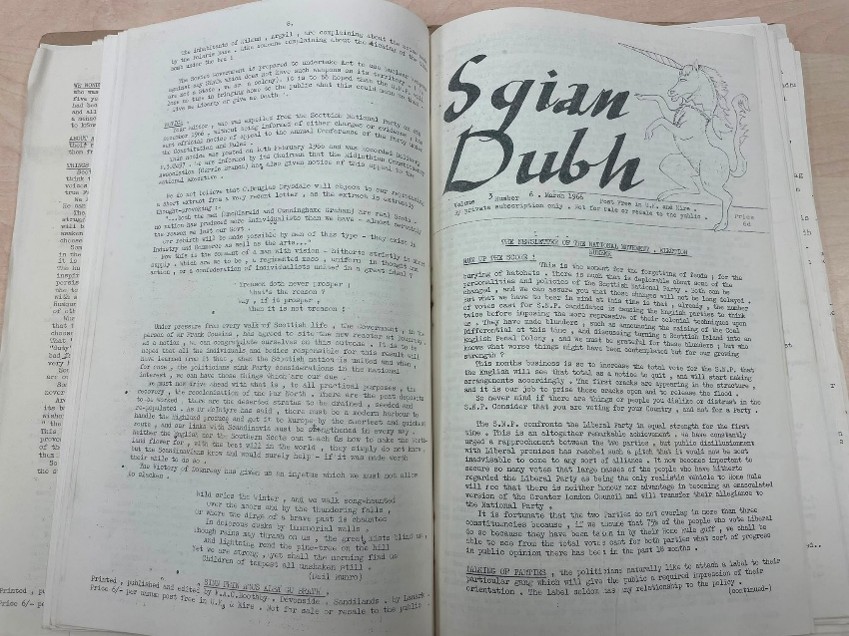
If you tried to research this periodical online, you would struggle to find anything that doesn’t relate to the traditional Highland dagger.This relatively unknown periodical began in 1963, and it was first and foremost a Scottish nationalist publication, run by F.A.C. Boothby. It was originally called Skian Dhu in its first volume, though this anglicised spellingwas quickly replaced by the traditional Gaelic Sgian Dubh by volume 2. Each issue was typewritten and stapled together. They were mailed to subscribers exclusively, and these subscribers were actively encouraged to recruit more readers so that publication could continue.
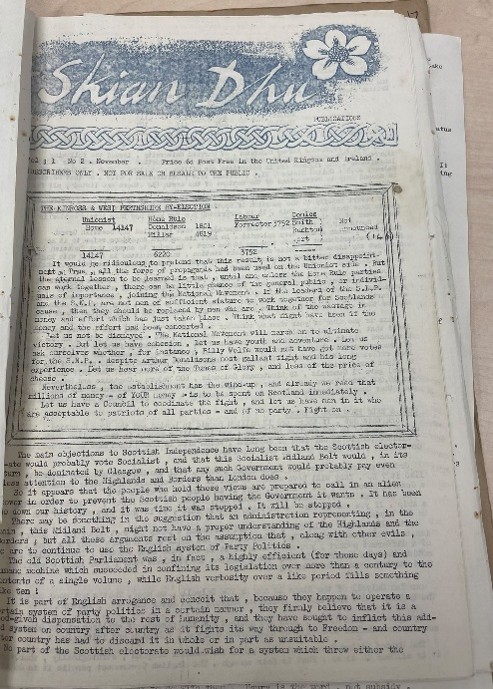
As part of Sgian Dubh’s cataloguing, I would take every issue and assess its condition, note down what topics were covered along with volume and issue number details. Throughout this process, I got to read some of the earliest volumes of this periodical and learn about its stance on a number of matters.
In its early years, frequent topics included The Acts of Union of 1707, the Declaration of Arbroath, Harold Wilson (or ‘Piggy’ as Sgian Dubh named him) and the Scottish National Party. Interestingly, the periodical took a dismissive attitude towards Highland and Gaelic culture in its early days, but this evolved over time, and by the release of its third volume in 1965, Gaelic articles began to be included in every issue.
Ewen Bain cartoons
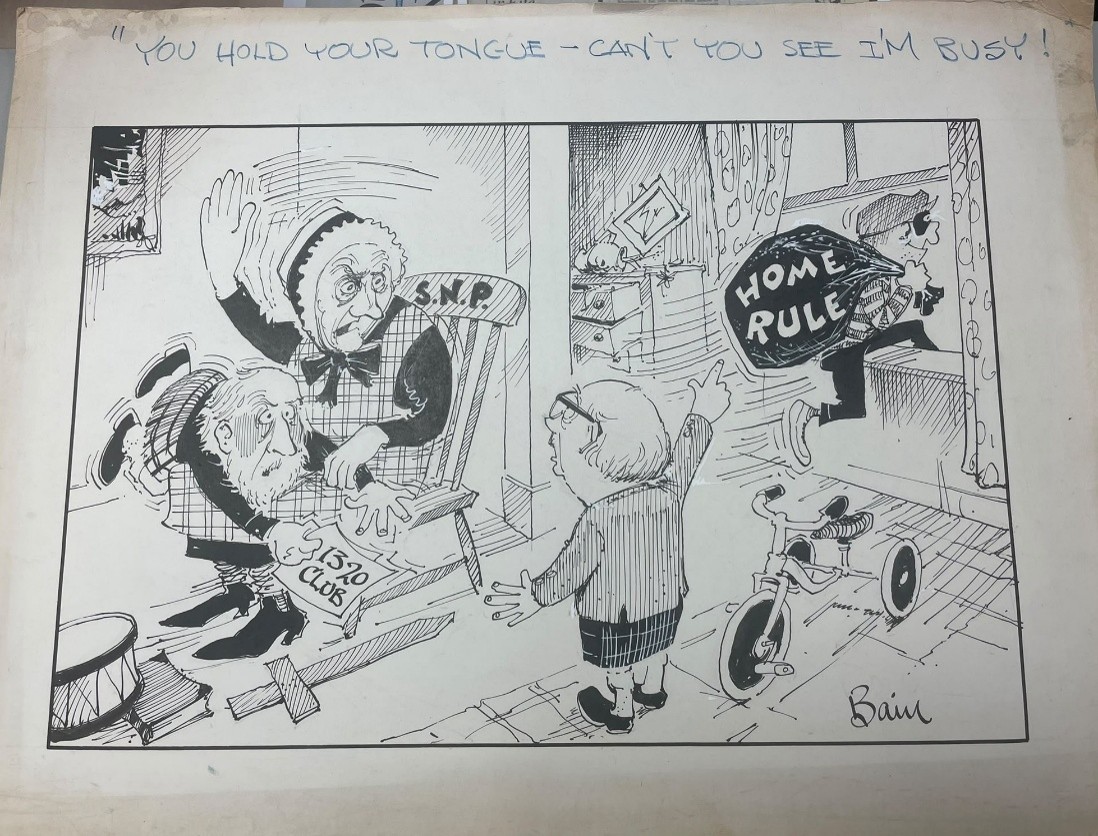
My next task was working with metadata to connect the image files for the Ewen Bain cartoons to their records on the online catalogue. Ewen Bain was a cartoonist who was most well-known for his long-running series Angus Og, a satirical cartoon set in the Highlands. Although I did not work with any of the Angus Og cartoons, my work revolved around his more political cartoons, specifically those featured in the Scots Independent newspaper. They often depicted topical political issues like elections, Scottish Home Rule and equal pay for women.
Scots Independent
Following my work with metadata, I worked with the Scots Independent, a pro-independence newspaper that is still in publication. It was originally founded by the Scots National League and continues to promote Scottish independence to this day.
I was tasked with selecting front covers to be used in a display for the newspaper’s centenary, which will take place in November. I combed through every newspaper we had available, from its first issue in November 1926 until the current decade. The most interesting part about this was to see the evolution of the newspaper over its one hundred years. The front cover design developed from one that was very text-heavy, without images or cartoons, to one that frequently uses large images for its headlines.
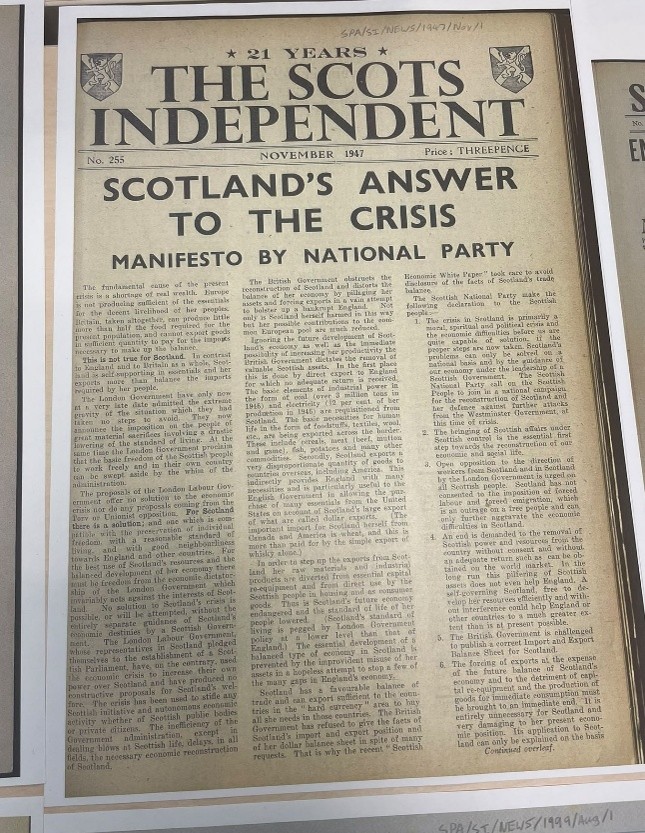
For the centenary, I chose one front cover per decade to illustrate this change in design and highlight the major events it covered in Scottish history, from conscription in the Second World War, the referenda of 1979, 1997, 2014 and the re-opening of Scottish Parliament in 1999.
After working on the display, I began to digitise the remainder of the physical Scots Independent issues, which finished the full digitisation project which had been started before my placement. This was one of the most rewarding parts of my placement, during which I got to digitally preserve some of Scotland’s political history, hopefully to be used in many research and personal projects to come.
