University Collections, which includes the Art Collection, also cares for other museum collections, including all of the ceremonial objects owned by the University. It comprises University silver, ceremonial gowns and the University mace, and other objects all used on graduation days. New recent additions to the Ceremonial Collection include newly designed ceremonial staffs and a new Mace stand. Where possible when new acquisitions are made to this Collection, we ensure that they utilise Scottish makers whose practice reflects the artwork contained within the Art Collections and the heritage of the institution. In this blog we focus on some of the most prized pieces in the Ceremonial Collection.
The Mace
William Kirk
Late 1960s
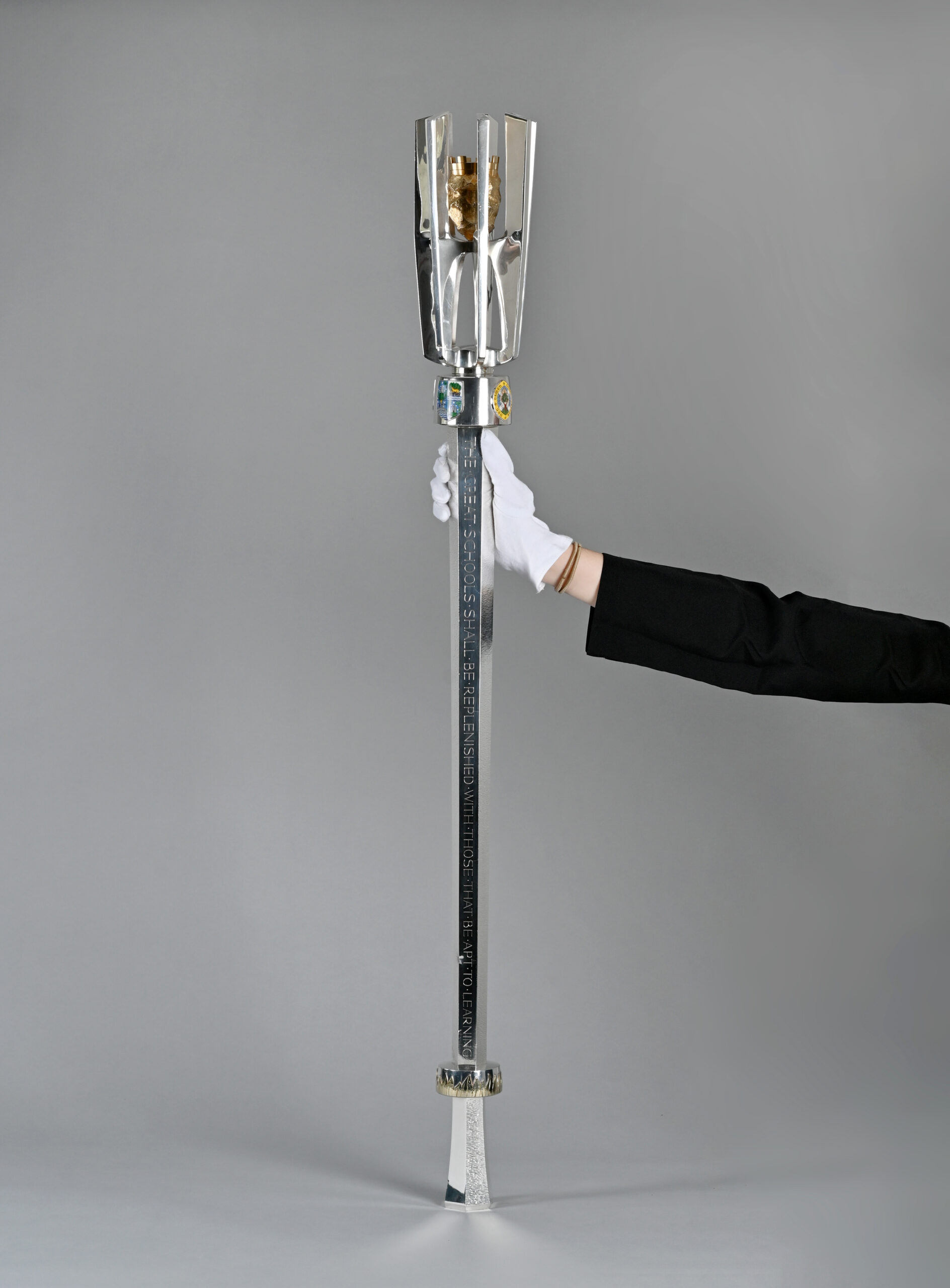
The jewel in the crown of the Ceremonial Collection is the Mace which is carried into each graduation ceremony at the front of the graduate procession. The Mace symbolises the University’s special status as a body incorporated by royal decree, and is the physical embodiment of the University’s power and authority.
Gifted by the congregation of Logie Kirk on 7th March 1968 to the University of Stirling to mark its foundation, the shaft of the Mace originally contained a scroll showing the names of the members of Logie Kirk whose generous support made the gift possible. (Because of concerns about the fragility of the paper, this is now stored separately).
The Mace was designed and made by William Kirk (1933-2009), an Edinburgh silversmith who was widely acknowledged throughout the jewellery and silversmithing community as a remarkable silversmith and influential teacher. After an apprenticeship in Edinburgh with Charles Creswick, he set up his silversmithing business in 1961 and taught at both Glasgow School of Art and Edinburgh College of Art and undertook a significant list of commissions.
William Kirk described his ideas behind the design:
The Head
The head is made of seven silver shapes joining together to form two compartments. The upper compartment encloses a rock form surmounted by a mural coronet symbolizing both the Castle and the Town ‘set upon a rock’. This part is in gold. the lower compartment forms seven half arches recalling the seven arched bridge in both the Burgh and University Arms.
The Knop
Set below the head is a silver knop. This is circular and carries in coloured enamels four shields being the Arms of the County of Stirling, the University of Stirling, the Burgh of Stirling, and the Church of Scotland.
The Shaft
The silver shaft is a slim tapered hexagon having the sides alternately smooth and rough textured. The three plain sides have engraved inscriptions reading:
‘The gift of Logie Kirk to the University of Stirling 7th March, 1968’
‘Keep hold of instruction, do not let go; guard her, for she is your life.’ Proverbs 4; 13 R.S.V.
‘The great schools…shall be replenished with those that be apt to learning.’ First Book of Discipline.
The Terminal Knop
This is a simple circular shape in silver decorated with flames in gold signifying the Torch of learning and the Burning Bush of the Church of Scotland. The shaft extends through the terminal knop forming an end piece. Set deep in this end piece is a lead communion token from Logie Kirk.
The booklet produced at the time of the presentation of the ceremonial mace ‘From Kirk to University’ contains much more information, and includes a reproduction of the words on the scroll. The booklet is kept in the Art Collection Archive.
This catalogue published by The Scottish Gallery to coincide with a memorial exhibition of William Kirk’s work includes a picture of him working on the mace for Stirling (on page 5).
https://issuu.com/scottishgallery/docs/william_kirk_towards_perfection_jan
New Mace Stand
Daniel Lacey
2024
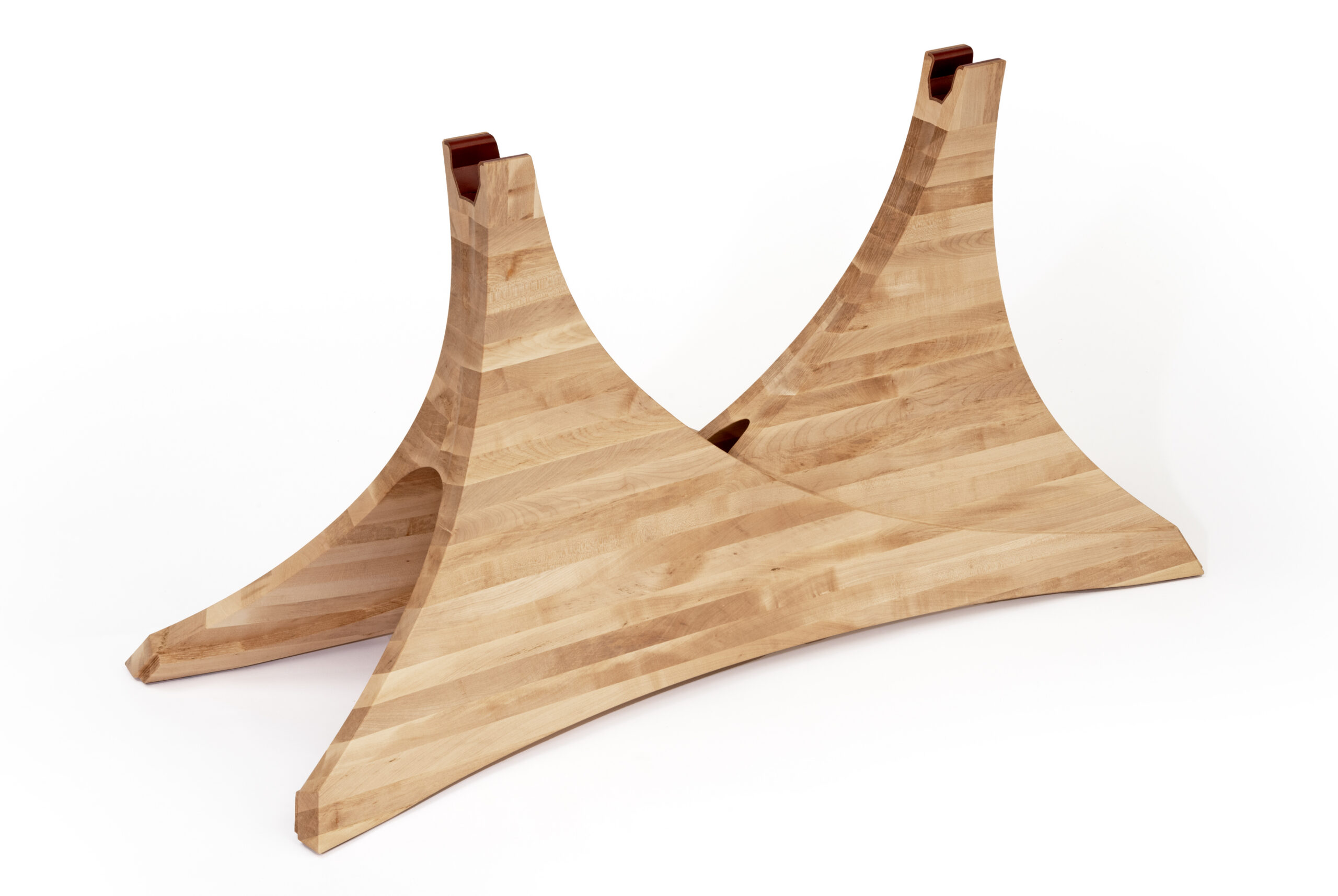
It was recently decided that the stand used for the Mace during graduation ceremonies needed to be replaced. Working with Jacqueline McKenna, Head of Gardens and Grounds, a previously felled sycamore from campus was chosen, and after research and consultation with the Scottish Furniture Makers Association, it was decided that Daniel Lacey would be an ideal fit for this project.
The design of the new Mace holder echoes our history as a plate glass University with nods to 1960s design, while retaining a clean modern finish. Daniel also designed and made a new graduation scroll holder to the same specifications.
Daniel Lacey is an award-winning furniture designer and maker. He is a graduate of the world-renowned Parnham College in Dorset and trained under such great makers as John Makepeace and Robert Ingham. His work blends functionality with sculptural forms and has a strong focus on creating work in harmony with the natural world, with sustainability at the heart of his practice.
In 2025 he was awarded the 500th Bespoke Guild Mark by The Furniture Makers’ Company.
Two new ceremonial staffs
Hamilton and Inches
2024
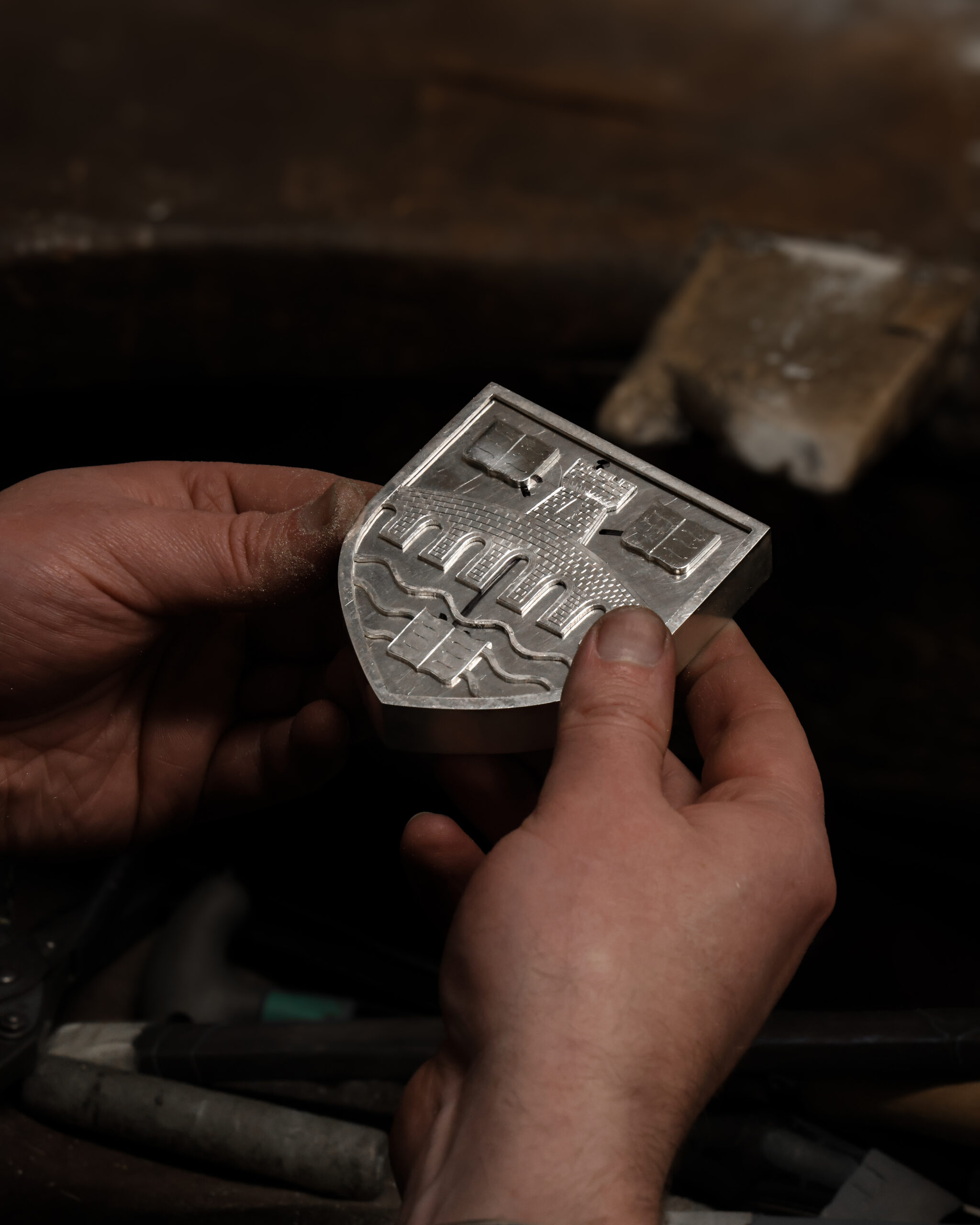
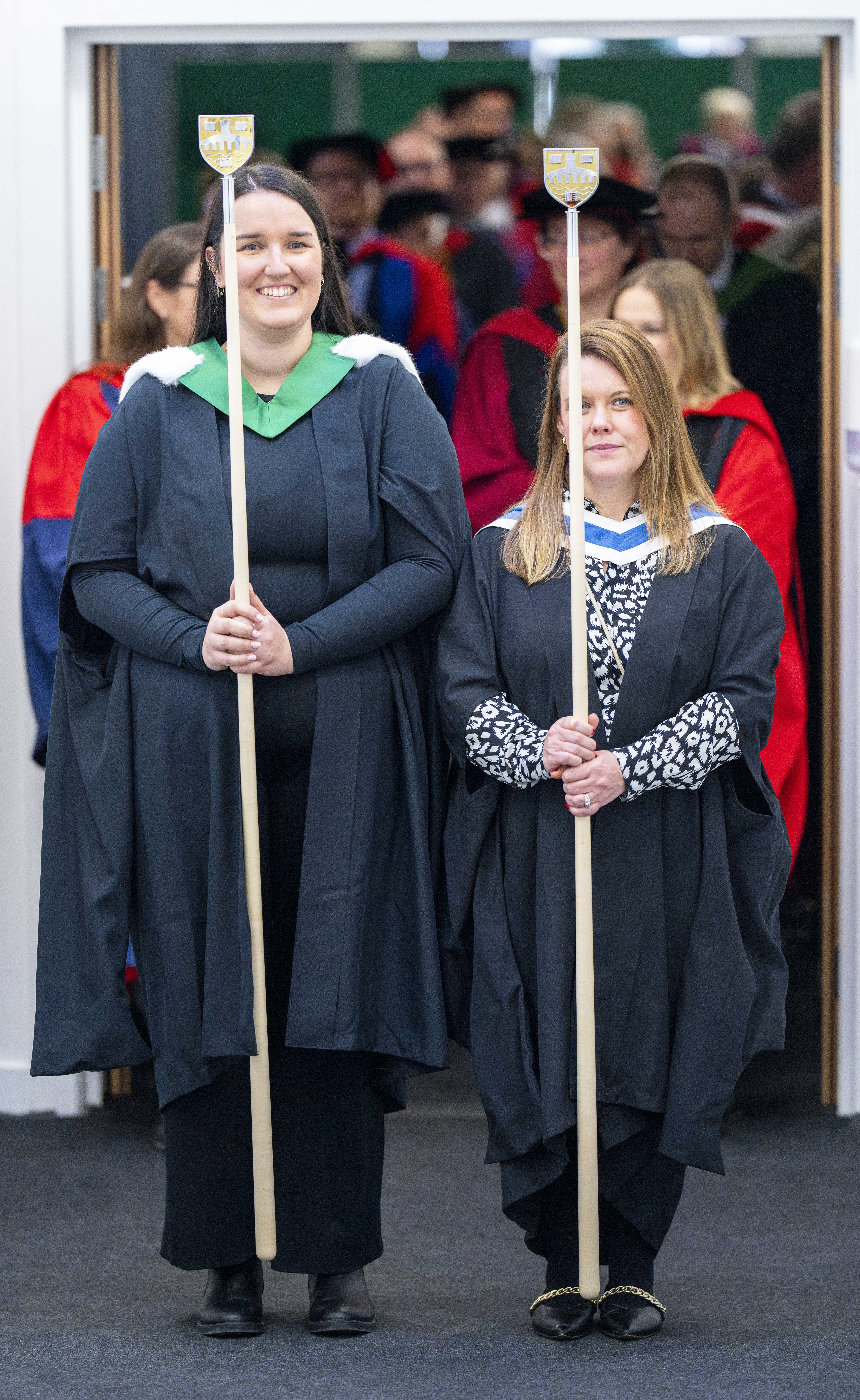
Two new ceremonial staffs have recently replaced the originals. Hand-crafted by the award-winning silversmiths at Edinburgh-based firm Hamilton & Inches, the ceremonial staffs were meticulously crafted to symbolise the institution‘s values and heritage.
The staffs are made from sterling silver and feature a variety of complicated techniques including scoring and folding, piercing and hand-engraving. Each element of the staff has been hand-made, including the screws and threads, enabling future repair work to be performed and thus securing the longevity of the piece. Even the wood has been painstakingly turned by the Hamilton & Inches team, bringing out the beauty of the maple. Collaborative working is at the heart of this sort of work. Within this piece alone, three different craft teams worked together, sharing their skills and expertise.
Each staff has shield-shaped University of Stirling coat-of-arms finials depicting open books, Stirling castle and Stirling Bridge and the River Forth in sterling silver, with gold plated background. On the reverse is engraved ‘University of Stirling’.
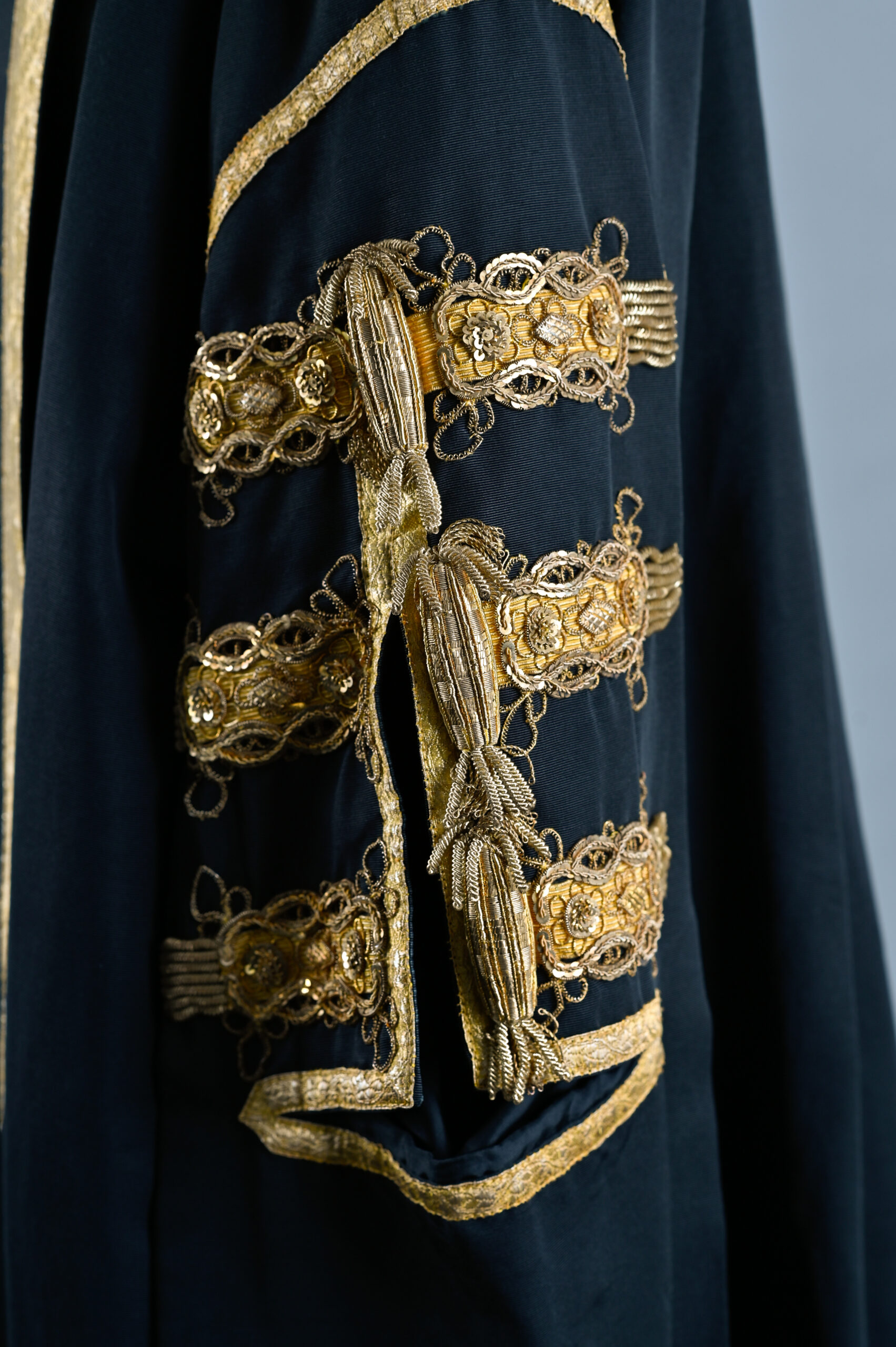
The Chancellor’s robe
When the University was founded, the Chancellor was the only officer with a special robe (the Principal wearing a dove grey silk stole over his own academic dress when deputising for the Chancellor).
The Chancellor’s robe is a traditional design with a flap collar. The cloth is black silk damask and decorated with gold lace. The ornate gold fastenings on the arms are called ‘Chinese frogs’. As the titular head of the University, the distinctive robes symbolise the Chancellor’s rank and authority.
James Naughtie, Chancellor of the University from 2008 until 2018, writes:
‘The Chancellor’s robes are a riot of gold, and at a graduation ceremony, in procession with a colourful gallimaufry of academic hoods and gowns, they shine out as they might have done in some medieval court.’
Read more of this text by James Naughtie in the publication ‘Fifty: the University of Stirling in 50 Objects’ (a copy is available in the Art Office, E1, Pathfoot).

The Principal’s robe was more recently updated to include the same gold lace as the Chancellor’s.
Blog about university portraits where some ceremonial robes are featured
University portraits – Culture on Campus
Silverware by Graham Stewart (1955-2020)
Trained at Gray’s School of Art in Aberdeen, Graham Leishman Stewart was one of Scotland’s foremost gold and silversmiths of his era. He established a workshop in Dunblane in 1978 and produced many significant pieces. For the opening of the Scottish Parliament at Holyrood he created the Three Honours sculpture, based on the Crown, Sword and Sceptre of Scotland, which was unveiled by the Queen.

Silver centrepiece candelabra Epergne
1995
This piece was a commission, made to mark Dame Diana Rigg‘s retirement as Chancellor (1998-2008), and later gifted back to the University by her.
The centrepiece has four detachable sconces for use as a candelabrum with four trumpet-shaped flower vases and central orb finial with curved supporting brackets between, on disc-shaped bases.
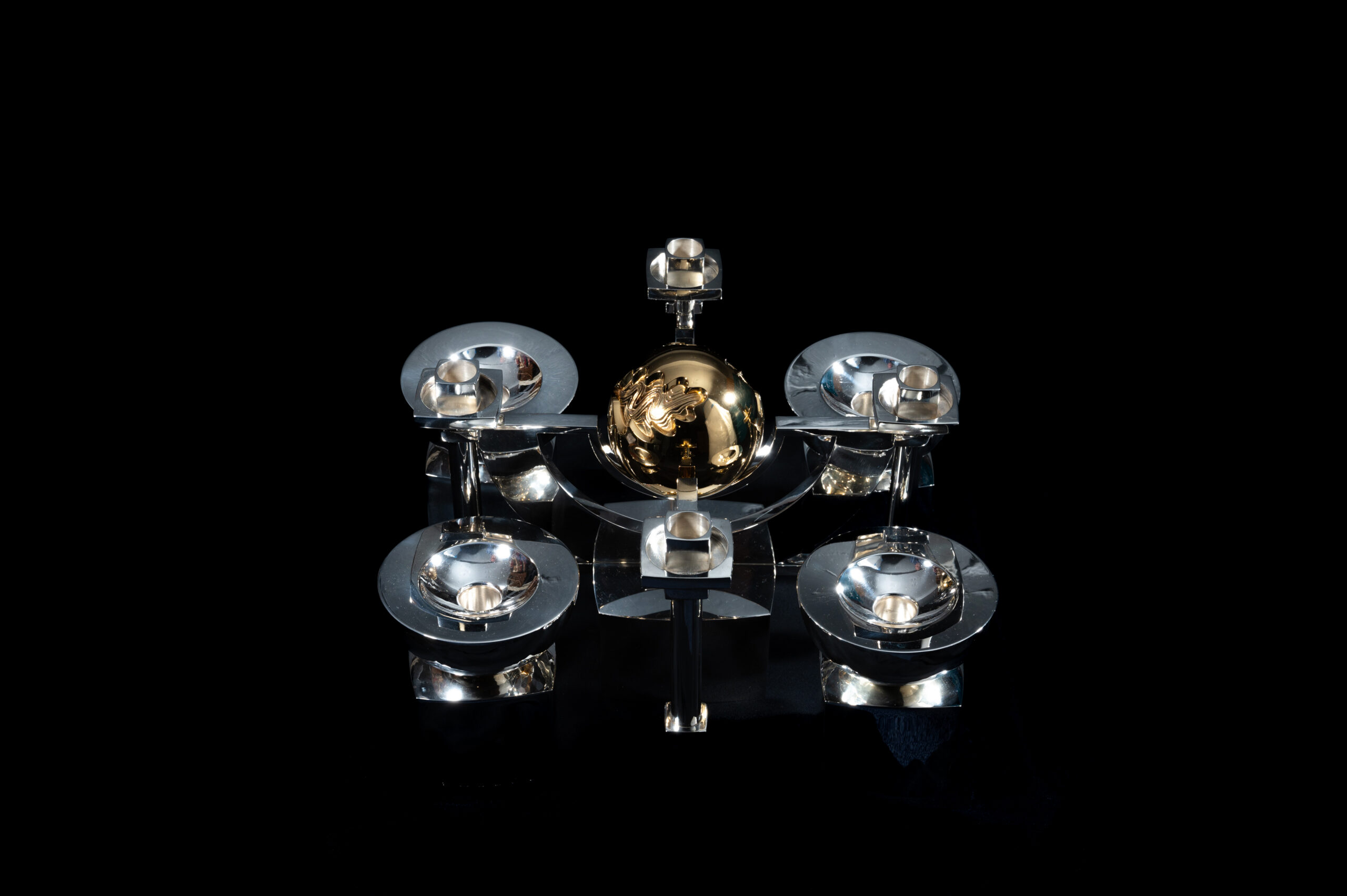
Globe candelabra & four candlesticks
2012-2013
Graham Stewart said that while creating this piece he believed he had been inspired subconsciously by an orrery (a mechanical model of the solar system) that he had seen in a museum. ‘There is a bit of the instrument maker about it’ he said, as the stems revolve around the globe at its heart. Four candlesticks complement the piece, their bowls referencing the globe, and the design also features two symbolic oak leaf motifs (symbols of renewal and the heraldic badge of the Stewarts).
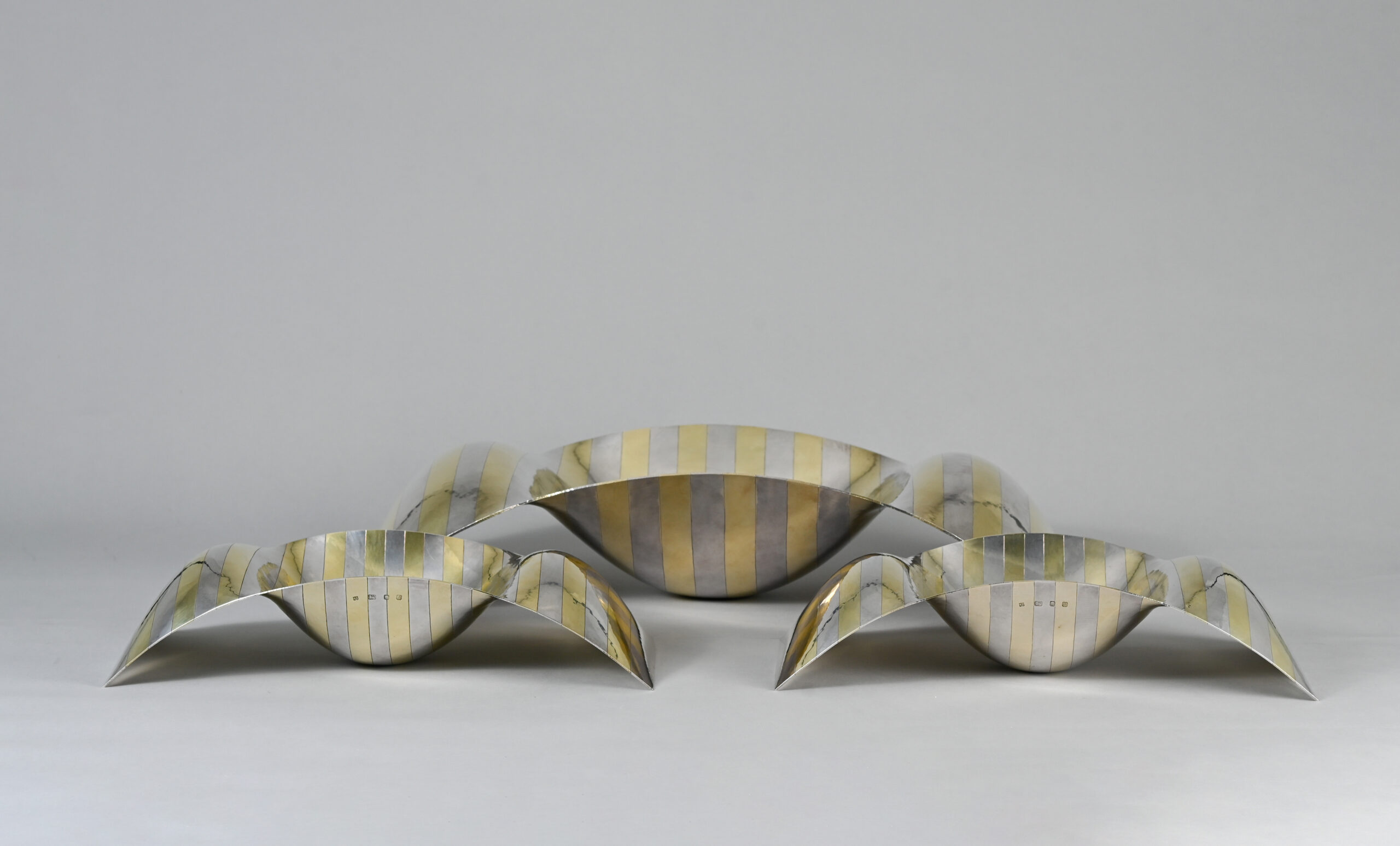
Silver and gold-banded centrepiece dishes: one large, two small
1968
Made by William Comyn & Sons Ltd, after a design by artist Hussein Abbo, this work was presented to the University of Stirling in the Goldsmiths Hall in London in December 1968.
The three bowls are made of sterling silver with gold bands, hand raised, each bowl is fashioned from a single piece of metal, and are in the form of a series of catenary curves. In physics and geometry, a catenary is the curve that an idealized hanging chain or cable assumes under its own weight when supported only at its ends in a uniform gravitational field.
Hussein Abbo (1935 – 2005) studied at Brighton College of Art (1956-60). He worked as a ceramics conservationist at the V&A (1963-4), and as Head Designer for William Comyns Silversmiths (1967-9), and continued work as a designer, sculptor and teacher following a move to California with his family in the late 1970s.
Hussein’s father was the artist Jussuf Abbo (1890-1953), born to Syrian-Jewish parents in Safed, who became an eminent member of the artistic community in Berlin in the 1920s, before being forced to flee with his family and find refuge in London in the early 1930s. Hussein’s two brothers also led creative lives: Jerome was a potter and Claude was a scenery and prop designer/maker for the BBC.
To see these items in the University Collections catalogue, click here
