It’s Gray Day, the annual celebration of Alasdair Gray and to celebrate Collections Volunteer Sophie Franks has been looking at Gray’s world and the works in our Collection here at Stirling.
Alasdair Gray was a Scottish artist and writer born in the Northeast of Glasgow in 1934 and later moved to Yorkshire England with his family in 1942 until 1945 once World War Two was over. Shortly after Alasdair’s arrival back in Glasgow, he was enrolled in weekly art classes at Kelvingrove Art Gallery and Museum, it was here where Alasdair started to form a foundation for his love of art.
Many of Gray’s creative works are set in and or inspired by various Scottish locations. Gray is famously known for his novels such as Lanark (1981) and Poor Things (1992) as well as his murals displayed across Glasgow. Gray believed that art should be assessable to everyone which led to the desire to create his art in public spaces such as churches and pubs. Gray aimed to make a creative space across the city of Glasgow, and those juices still flow through the city today. Gray studied at Glasgow school of art from 1952-1957 and upon graduation he proceeded to gain some income as a mural artist and in 1959 as a part time educator. Gray was painting murals in Glasgow from 1955 until 2004 with his most recent one remaining unfinished, his first commissioned mural is titled ‘The Horrors of War mural’ 1955-57. The mural was painted as part of the USSR friendship society and displays the horror of warfare and nuclear destruction while still sticking to the upward Glasgow landscape. Post Graduation Gray painted murals at Greenhead Church of Scotland 1959-63, The Scottish Wildlife Mural in 1974, a mural at the iconic Glasgow location the Ubiquitous Chip 1979-82 and the unfinished mural in Oran-Mor from 2004 to present day.
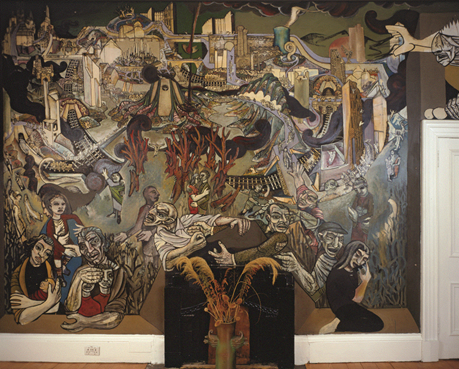
‘The Horror of Wars Mural’ 1955-57 by Alasdair Gray (The Alasdair Gray Archive)
Here at the University of Stirling Art Collection, Gray donated eleven pieces himself in 1984 after politely declining an honorary doctorate. The prints he donated include; From an Eastern Empire (1995), From the Souls Proper Loneliness (2005), That Death Will Break This (2005) and Domestic Conversation (2008). All of which you can find in the B corridor of the Pathfoot building.
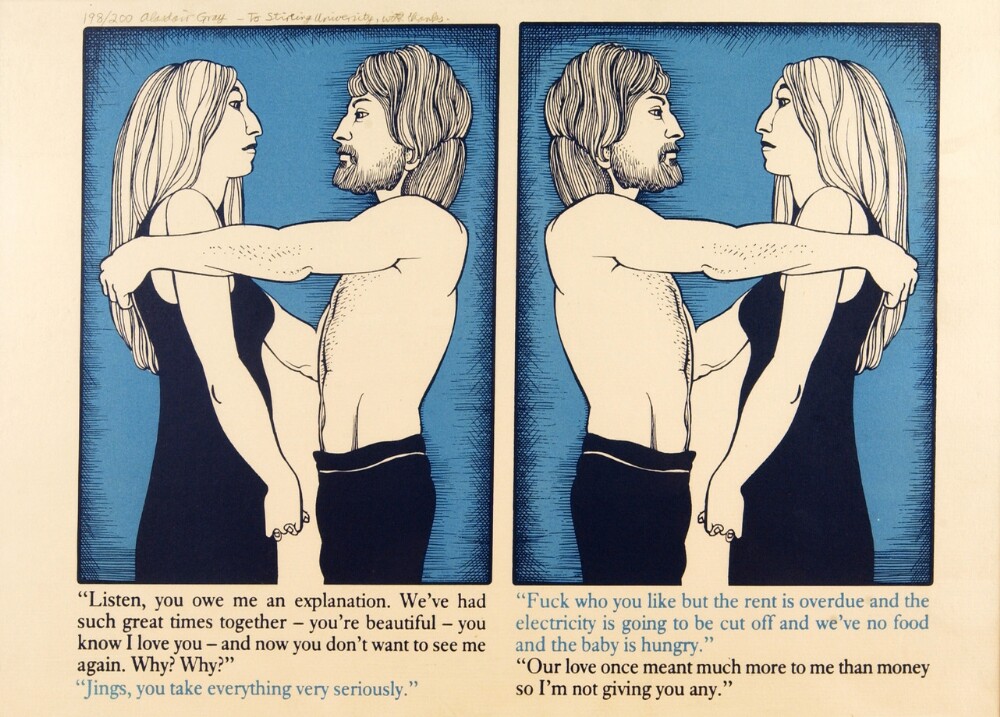
All covers of each Lanark book are also displayed here and they give the reader an image of what to expect. As a viewer I found the prints show raw emotion, often challenging or angry with a humorous aspect to them.
Written over thirty years, Lanark is a life in four books, where Gray weaves between autographical fiction and dystopia between the four works. Books two and three reflect Gray’s own life as he mentions wartime evacuation, his time at secondary school and Glasgow School of Art, as well as his struggle with creating normal relationships with women. While books one and four, the City of Glasgow is changed to Unthank. A dystopian view of the city, where citizens are alien in appearance with a disease called ‘dragon hide’. The prints on display at Stirling, demonstrate the biographical nature of the book as his family and friend’s portraits are displayed on the covers as well as the fantastical, demonic and ever-intriguing imagery that Gray is so well loved for today.
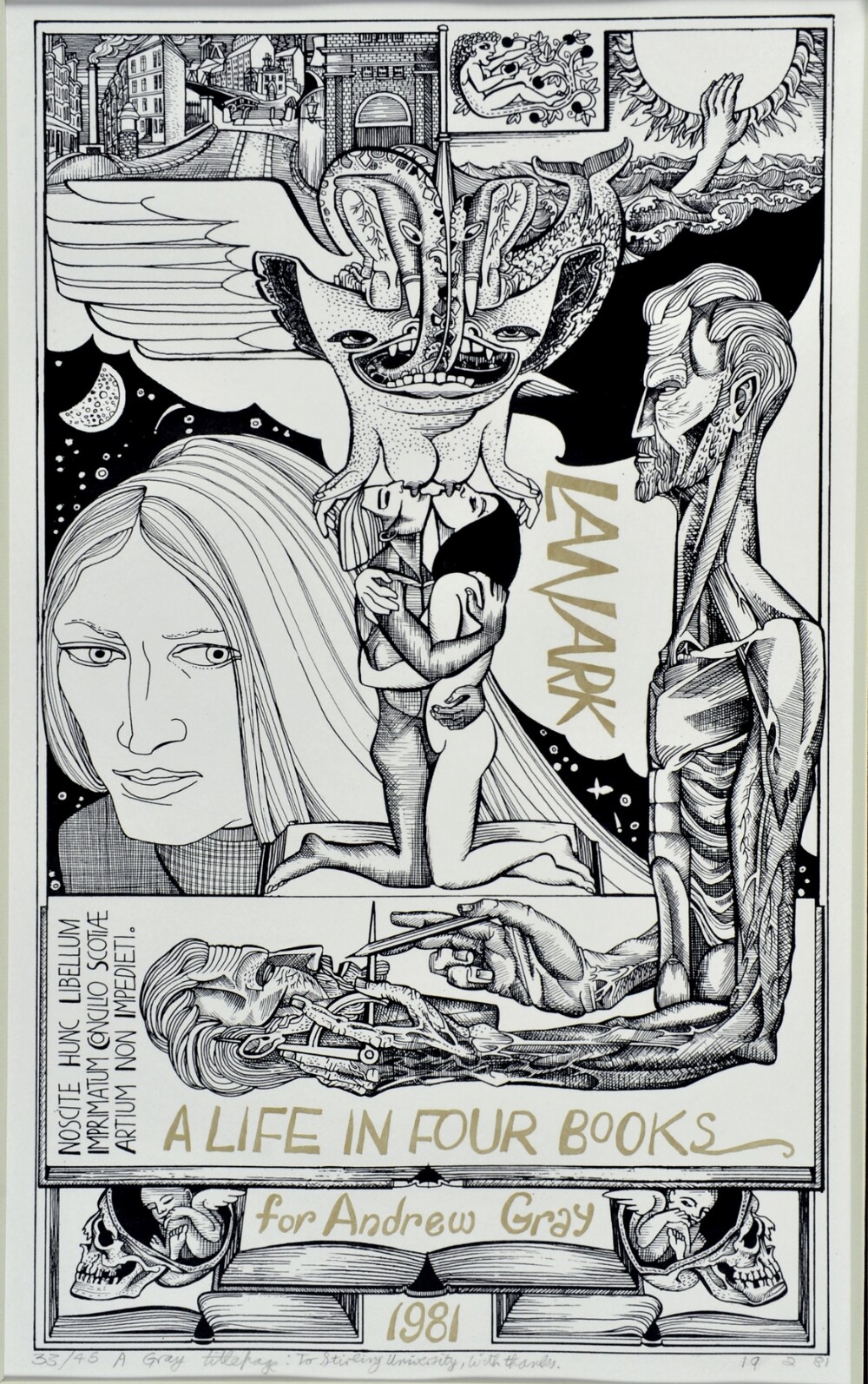
Gray’s artistic vision is often political, although it has also been described as dark and surreal. His work often sends an important message to the viewer such as in Poor Things (1992) which considers objectification of women or in Lanark (1981) focusing on the destruction of society.
Alasdair Gray is an enduring icon in the Scottish art world; his talent brings people together and has strengthened and inspired the arts community with his creativity and humanity. Be sure to check out the Gray Day Programme in Glasgow, which is packed with events!
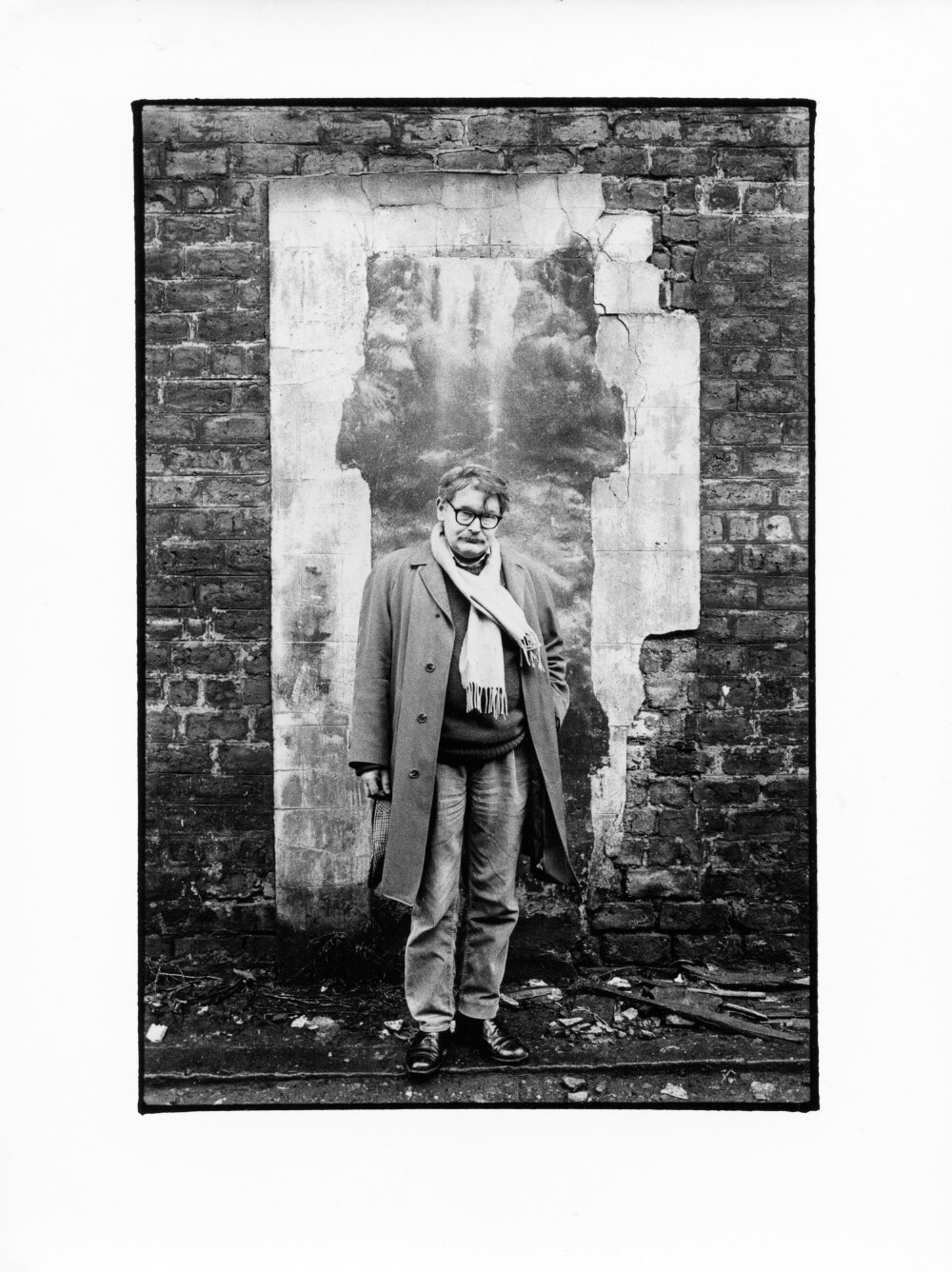
All donated works by Alasdair Gray can be found in the B corridor of the Pathfoot building, which is open 9-5 Monday to Friday.
References:
The Hunterian
The Alasdair Gray Archive
Alasdair Gray: Making Murals – Historic Environment Scotland Blog
Lanark by Alasdair Gray
