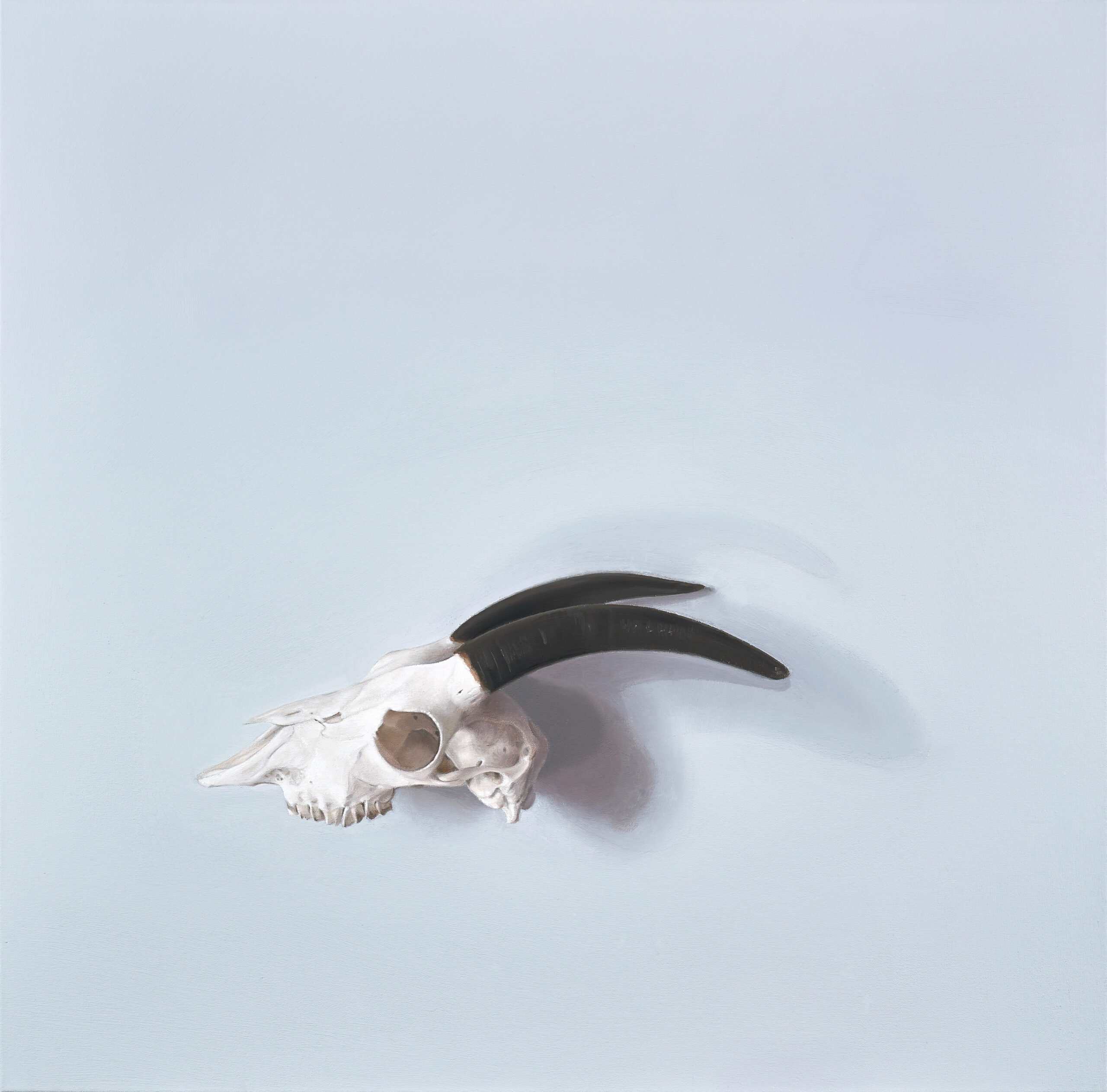
Alison Watt is an eminent Scottish artist who won the National Portrait Gallery’s annual award while still studying at the Glasgow School of Art in 1987. The University of Stirling Art Collection is proud to feature one of her works, Le Bouc. This painting is significantly linked to the University’s history. Alison Watt’s work has been inspired by the portraits of Adam Ramsay, a close friend of Robert Adam, the architect of Airthrey Castle (1791) on campus. At Watt’s request, Le Bouc was displayed in her exhibition A Kind of Longing in 2023 at Tristan Hoare Gallery, a Georgian house in Fitzroy Square in London, designed by precisely the same architect, Robert Adam, in 1792. In such a venue, Watt’s work seemed to be allocated into a context that suited it, as a natural environment for it. Similarly, Le Bouc coherently integrates into the university collection, and its presence strengthens a sense of continuity.
Le Bouc is not only firmly rooted in the University of Stirling’s history, but in dialogue with its present. Aiming to foster a connection with the students’ interests, it has been on show at Pathfoot Building as part of the Art & Science themed year of exhibitions, alongside artefacts of the University’s Natural Science Collection. Although not strictly a still life nor a portrait of a goat’s skull, Le Bouc shares characteristics that align with the aims of 18th-century still life painting. At the time such works, among other purposes, explored scientific interests and displayed artistic virtuosity. In the case of Le Bouc, it is indirectly related to such aims because Ramsay himself painted during the Scottish Enlightenment. It therefore fits naturally into the current exhibition.
On the other hand, Le Bouc differs from an 18th-century still life in that it does not seek to depict wealth nor convey a moral message about it. It shows no extravagance nor excess; rather, ‘It does things quietly, it doesn’t shout – it whispers,’ as Watt describes her own work. It is not strictly a portrait either, but rather a style that incorporates elements of both painting genres, creating a style unique to Watt.
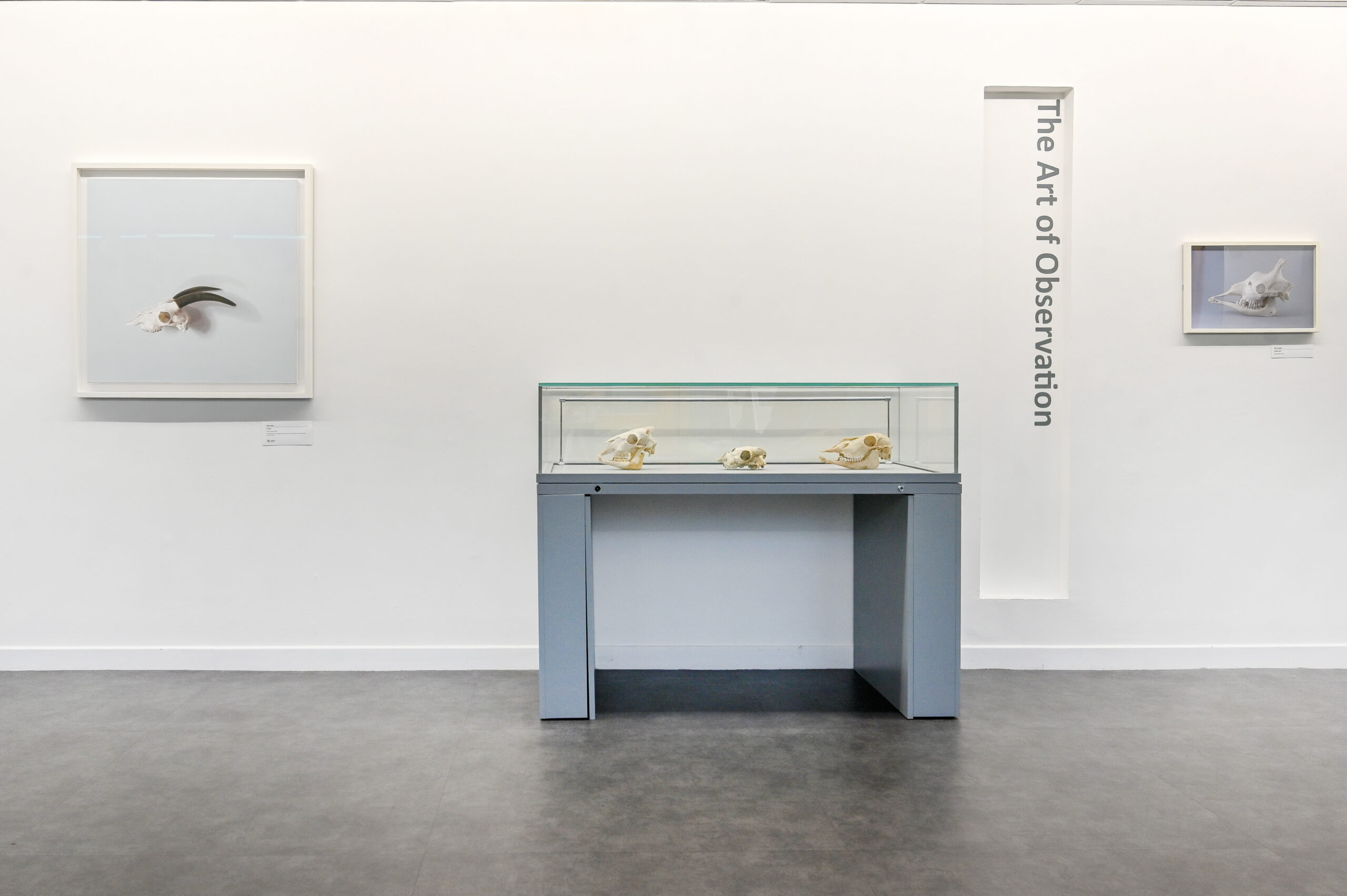
Photo by Julie Howden
Known for her detailed studies of fabric and light since the 1990s, Watt has also depicted flowers, notebooks, skulls, parts of human bodies, and parts of sculptures. In such works, it is possible to perceive the essence of things, an intimate look at these objects, as well as attentive affection and care. In the artist’s own words: ‘I think still life can be incredibly intimate. Because we attach so much meaning and significance to objects, they reflect us. They are a form of biography. As far as I’m concerned, the still life is a portrait without likeness.’
Le Bouc became part of the University Collections in 2024, thanks to the National Fund for Acquisitions, David Armstrong and The Art Fund.
This piece will be on show in the Pathfoot Building at the University of Stirling until 7th August 2026.
Bernardo Sandoval
Bernardo Sandoval is a PhD candidate at the University of St Andrews, writing a 19th-century social and political history thesis. He is doing a SGSAH internship in the Art Collection of the University of Stirling. He likes to work with archives and make publications and exhibitions.
References
National Fund for Acquisitions application document by the University of Stirling .
Some photographs provided by Tristan Hoare Gallery.
Installation view of Le Bouc in the Stirling exhibition: copyright Julie Howden.
