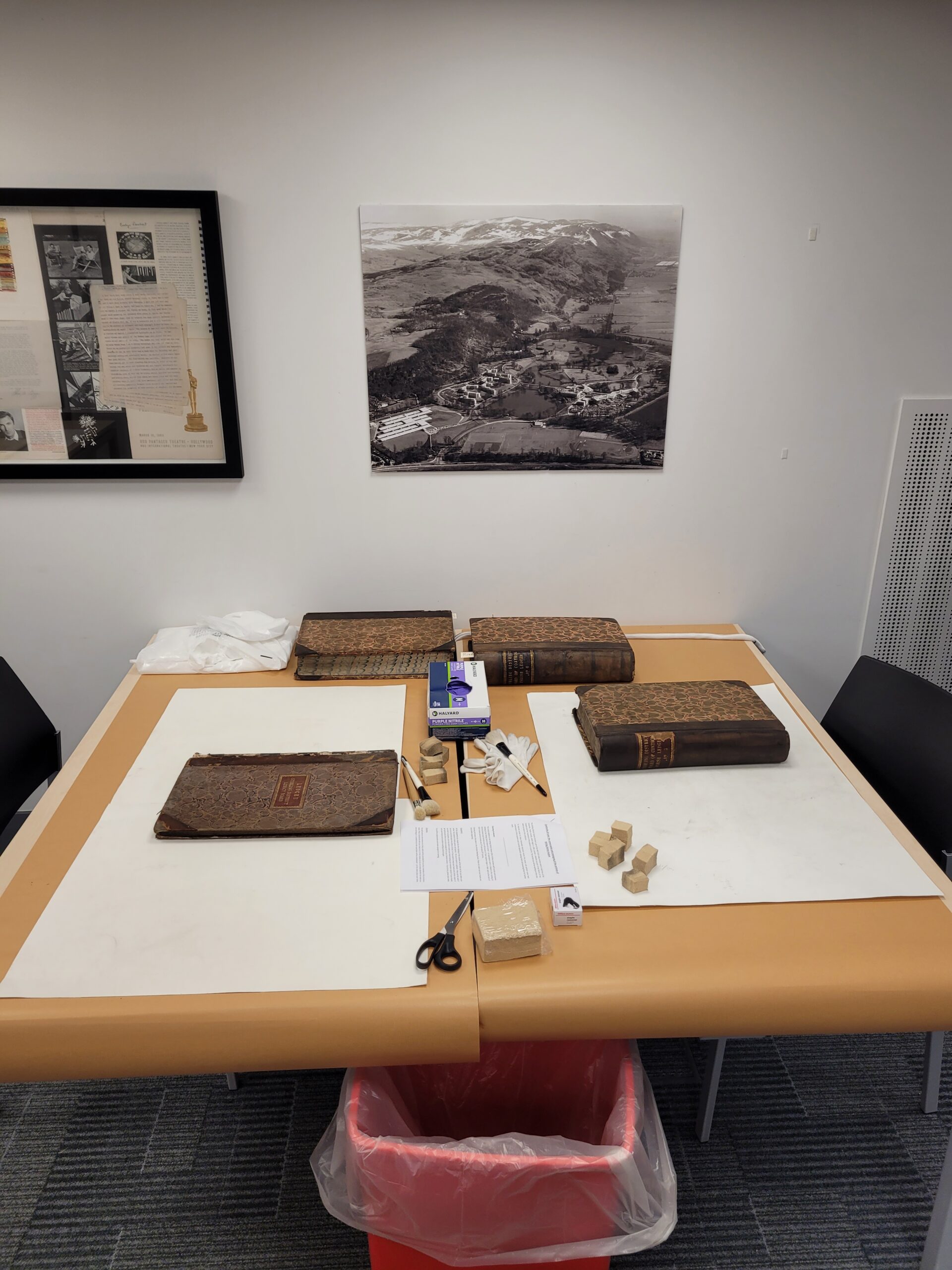
We were incredibly fortunate to receive a new donation to the Stirling District Asylum Archive before Christmas. This donation, from a private collector, adds our first staff records to the archive and provides unprecedented insight into the administration of the Asylum from its very first years through rich documentation, detailing the sale of land and building of the hospital onwards, and ledgers and letter books which demonstrate the establishment and continuity of a number of boards designed to aid the running of the institution. We’re enormously grateful for the deposit, which students have already been making much use of in class and coursework.
This semester, Katie, a placement student from Strathclyde University, worked on a selection of these records. Her work helped us to better understand the records that we now hold and how the Stirling District Board of Control fit into the workings of the Asylum. Here is Katie’s research report from her placement.

The University of Stirling archives recently received a donation of material relating to the Stirling District Board of Control for the Stirling District Asylum. However, little was known about the Board and the purpose it held. By combing through the relevant letter books and records of patients in this deposit, a better picture of the role and history of the Board of Control has emerged.
Due to the increasing demand for institutional care for those deemed to be insane, a number of government acts were implemented to improve asylum care. The Lunacy (Scotland) Act of 1857 established a general board of commissioners in Lunacy for Scotland to oversee asylum management and patient welfare in the various counties. In order to broaden the scope of individuals cared for in the asylum regime, the Mental Deficiency and Lunacy Act of 1913 was introduced, establishing the General Board of Control for Scotland to oversee the management and protection of “mentally defective” individuals. Parish councils and school boards were tasked with identifying and managing any such individuals under their jurisdiction, leading to the creation of the Stirling District Board of Control.
The Board of Control was not an entirely new body, previously existing as the Stirling District Lunacy Board, the Board of Control worked in a similar way to its predecessor. The Board was made up of the four Counties of the Stirling district alongside the three larger Burghs of Stirling, Dumbarton, and Falkirk. Working as a statutory body, the Board had the duty of providing suitable accommodation for those deemed to fall under their care and were empowered to contribute towards the expenses of maintenance for such individuals in an institution. In practice, parish councils would identify suitable candidates and place them in the care of Stirling District Asylum. The parish would then contact the Board of Control, claiming 50% of the cost of maintenance from them. The Board would pay this half and use grants from the government to cover the remaining costs.
Through reading the letter books and patient records from the Board of Control, it was not just local parishes that were the responsibility of the Board. Patients from as far as Shetland found themselves housed in Stirling District Asylum, with Stirling’s Board of Control having to liaise with Boards of Control all over the country to provide suitable care and coverage for patients.
The Board of Control did not just care solely for patients. Correspondence in the letter books showed that the Board also helped to look after staff members through building new lodgings for married attendants and listening to complaints from staff regarding long working weeks – in fact, Stirling became the first Asylum Board in Scotland to introduce the 48-hour working week for staff. Furthermore, the Board was also responsible for the purchasing of land to provide expansions to the asylum, as seen through the purchase of the Kinnaird Farm Estate.
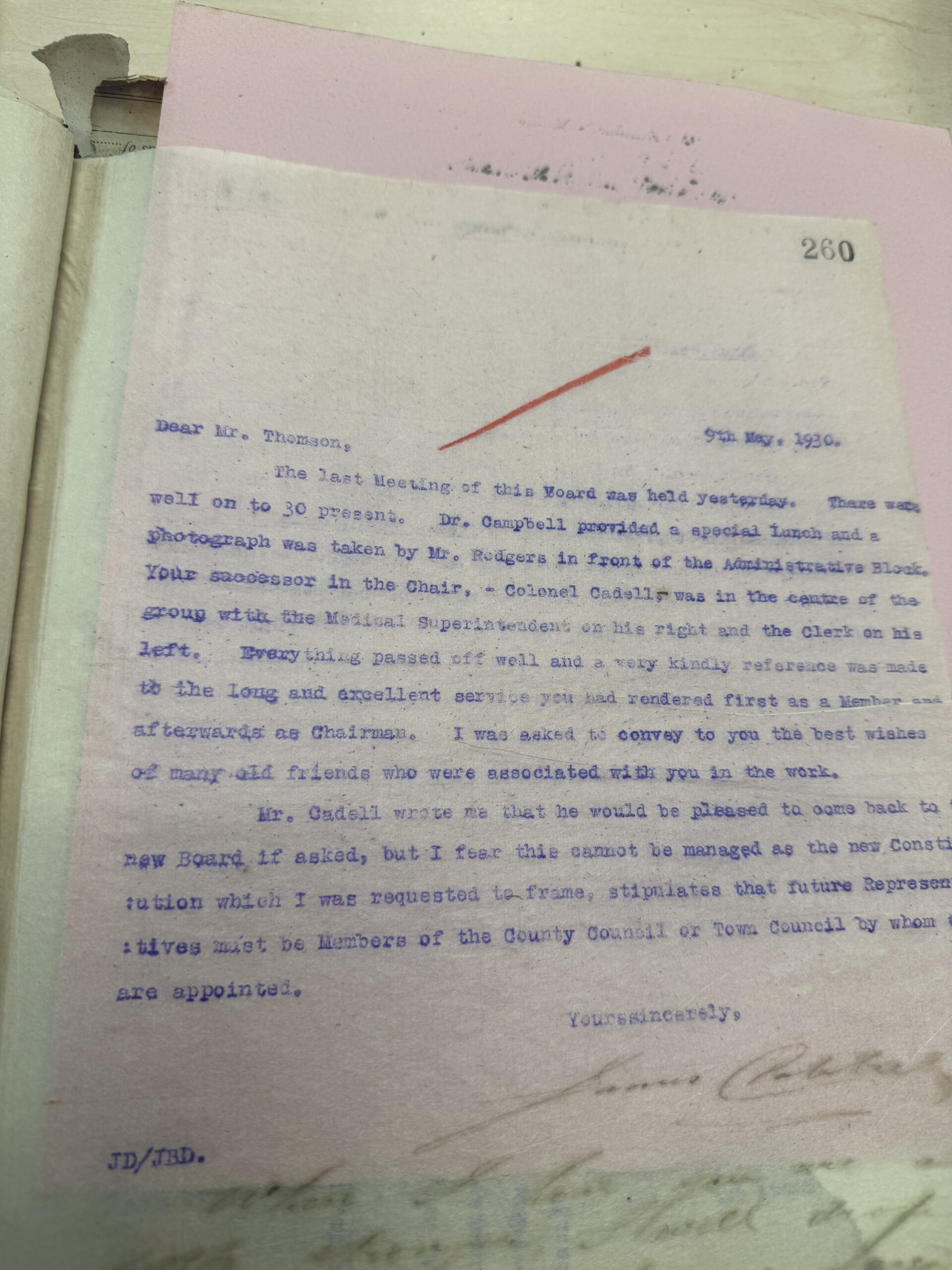
Despite functioning successfully, the Board of Control ceased to exist on the 15th of May 1933. This came as a result of the 1929 Local Government Act, which had the aim of centralising mental health administrations under town and county councils, hoping for greater efficiency and better coordination with asylum services. The Board of Control was therefore replaced by the Joint Committee for Stirling District Asylum. The committee had 25 members and, unlike the previous Board of Control, included representatives from the Burgh of Clydebank and the county clerks for Stirling, Dumbarton, West Lothian and Clackmannan, to name but a few. The Joint Committee was not a statutory board like the Board of Control, meaning it held less overall power than its predecessor and had to consult all counties and burghs before acting. The way in which patient fees, grants, and loans were paid all changed after the shift to Joint Committee, meaning that counties and burghs had to make their own arrangements for patients. This led to significant miscommunication and a disjointed relationship between the counties, burghs and joint committee members. Around half of the Board of Control members were re-elected to join the Joint Committee, however, correspondence in the letter books show that feelings of discontent regarding the new committee and its powers were common. Moreover, the new Joint Committee found themselves involved in a standoff with Glasgow, who had initially been in talks to join the new Joint Committee but pulled out at a later date. Glasgow claimed they were entitled to monetary compensation as they would be missing out on receiving the assets split between the counties and burghs after the dissolvement of the Board of Control, despite never being a member of the original Board of Control. A settlement was finally reached but the letter books show that this was not an easy resolution to come to, with negotiations taking many months, highlighting the complex internal politics of the Joint Committee. Despite continuing to cover a similar role as that of the Board of Control, the Joint Committee did not seem as straightforward to operate, with the counties struggling to source the relevant grants to cover board for patients as this was previously done by Board of Control.
Although not confirmed by any material found in the archives so far, it can be ascertained that the Joint Committee most likely stayed active until the introduction of the National Health Service (Scotland) Act 1947 which marked the end of local authority control over mental health institutions. By understanding the role of the Board of Control and its successor, a deeper knowledge of Stirling District Asylum emerges. This paired with the Stirling District Asylum material already housed in the archives provides the perfect setting for further research on Stirling District Asylum and Scottish mental health institutions as a whole.