Our Artist in Residence in conversation with Harriet Crisp
Midway through the production of her FORTH2O-funded artist moving image project, Jess Holdengarde discusses the multiple properties of water, analogue processes and slowness, and interdisciplinary knowledge exchange and policy innovation.
Harriet Crisp (HC): You’ve previously spoken about water being a carrier, a collaborator, and a teacher. Can you expand on this perhaps slightly unusual way of thinking of water?
Jess Holdengarde (JH): In my practice, I have understood that when I’m working with the environment as a material that is processing film or photographs, or is part of the making of the sound, then it’s not just a material, it is also a collaborator – it is the thing that is working with me to create something and in turn, I’m responding, reacting, and building a relationship with it. When this project came my way, I moved into being held by water as a theme because I had connected with Hydro Nation Chair and FORTH2O. Through that, the water became this vessel, which guided me materially, thematically, and personally. I am moving with it to create a body of work and am guided by it to other people responding to and working with water.
HC: It seems that the material and formal properties of water are informing your practice.
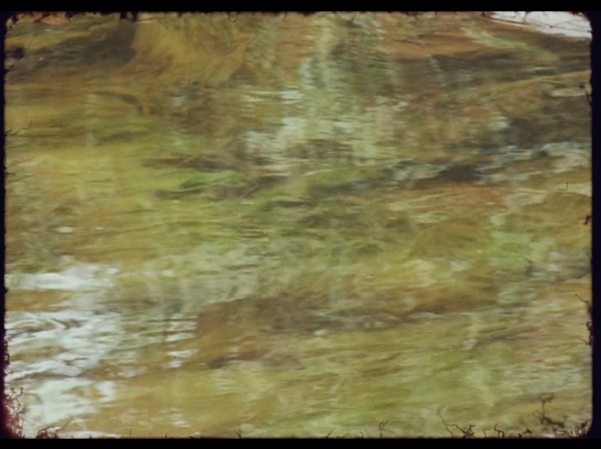
JH: When I was thinking about this project, I was sitting with Margaret Tait’s poem about water. She spoke about water as a compound that is moving. I was responding to this idea of something oscillating and constantly in motion. Through making this film, I have been thinking about how water itself is all about movement and energy, and how that really meant that I needed to make a film rather than work with still images. I was responding to her talking about how water is formed, and movement and flow became central to the work.
The formal and material properties of water are also supporting me in making the film itself. They are coming into the work through the process of literally developing parts of the film with river water and also through the sound design. Water is not only the subject of the work, but something that is actively participating in how the film is made. Its movement, materiality, and energy are embedded within both the process and the final form.
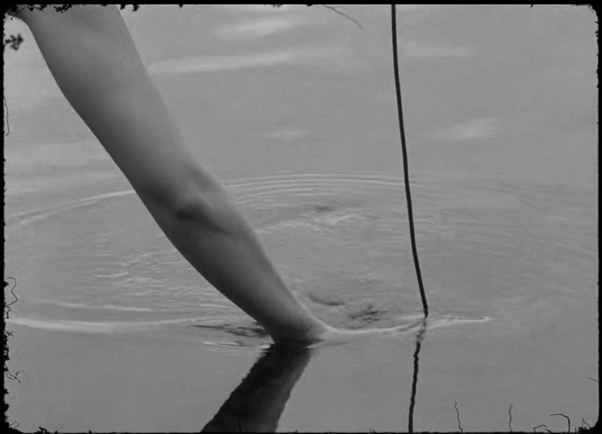
HC: You’re using an analogue format and the river as a material in your filmmaking process. What has informed these decisions?
JH: Analogue is actually very important in my practice. As a medium, it is about slowness, time, and consideration. I tend to think about conscious ways of making. As practitioners, we are often having to work very fast to meet markers and expectations, but when you are trying to make work that is sensitive to the environment, to the state of our crises, or to questions of policy – which a lot of my work is trying to talk about – I think we need to be a bit more conscious, aware, and in tune in all facets of our lives.
For me, working with film is about that. It is about being quite in tune. To feel embodied, I need something tangible. The handling of film is very important to me. I want to be able to feel it. I want to run the film through my fingers and literally feel in touch with it. I love understanding that when light, time, and silver are all operating and colliding with one another, they create an image that sits on a tiny strip of 16mm film. To me, that is where the magic is, and that is what I am completely devoted to.
When I think about the research, it is all about devotion – about the things that we become committed to and even obsessed with. For me, if I am responding to themes around care, attention, and consciousness, then I need to practise those values through the material itself. The process and the medium have to embody what the work is trying to say.
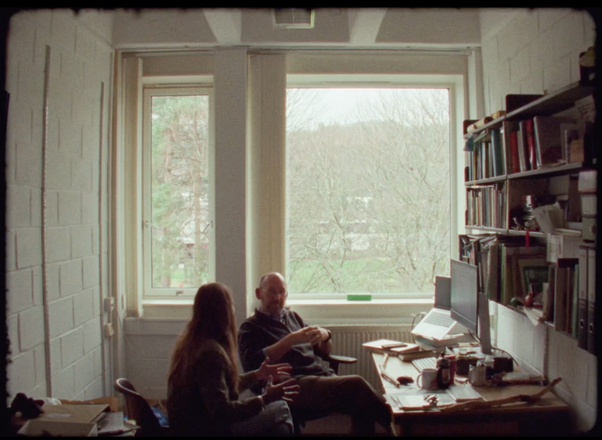
HC: Your project engages with researchers from across different disciplines investigating water. What parallels and divergences have you encountered so far between your filmic processes of capturing water and their research methods of capturing water?
JH: For me, the common thing is devotion. As an artist, I will move mountains to work on a subject that I feel devoted to. At the same time, when working with people like Nigel Willby and Andrew Tyler, I was struck by how they too are completely devoted to their practice of water management, policy, and finding solutions to environmental impacts. In a way, we’re doing the same thing, just with different lenses. We’re finding ways to work through polycrisis together. The difference is how we translate the thing that we care about. That’s where I feel it’s very important that we are working together – I’m using embodied, cinematic, and artistic tools and responses, whilst Andrew and Nigel, for instance, are very much working with data. We need each other to help each other reach different audiences and to learn from each other.
HC: What challenges of interdisciplinary working have you encountered so far?
JH: One challenge has been around output. Some see the film as a documentary for me to support the research that’s happening around water and to change minds. To me, that’s a very policy way of thinking. I’m still working through how the output is going to be. Right now I’m thinking about the process and there are answers within those moments of making. There are answers in these moments of exchange and collaboration that are not going to be something that you can capture as data or as a document that can support a policy negotiation.
HC: Do you intend for your project to inform policy? And if so, in what ways are you engaging with policy audiences? It seems you’re actually doing that already in working with these scientists.
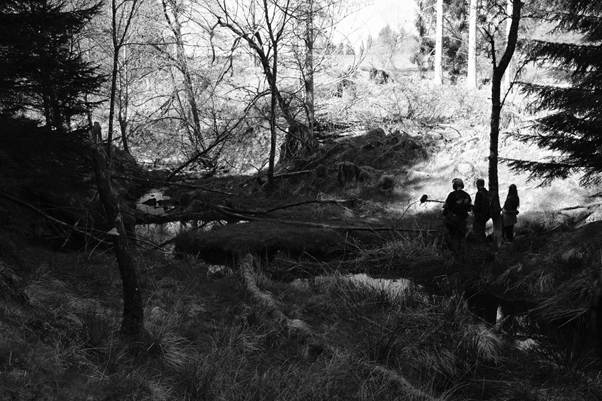
JH: My hope is that the process is the thing that helps inform policy. What I hope policymakers will see in the film, and in the making of it, is that we need to think about different ways of approaching things, that policy cannot just be from data, and that innovation happens through change, collaboration, and learning. I believe that innovation in policy is going to happen through experimental spaces and that’s my job. A lot of the time, in the process of this production of the film, things happen that are messy and unexpected. We’ll be talking with someone like Nigel, then all of a sudden, a beaver shows up and we’re having to pivot, shift our lenses and capture the beaver. Every time I’ve looked back at moments like these, I’ve realised that it’s not about this perfect, clean film output – it’s about the messy and the in-between, it’s about the process of the making. We need to be with each other, be aware, and learn in those transitional moments. But I think what’s beautiful is that with a project like FORTH2O we have the opportunity to learn! I hope that’s why I’m here.
